If water pours straight out of a pot while its center stays dry, the root ball may have become difficult to rewet. A gap between the mix and pot wall can channel water past the roots, giving the impression that watering is complete. Check the center before adding more. Rewet in slow stages and allow drainage afterward. A heavy pot already full of water needs a different diagnosis, so confirm dryness rather than assuming every wilting plant needs soaking.
Confirm the dry center
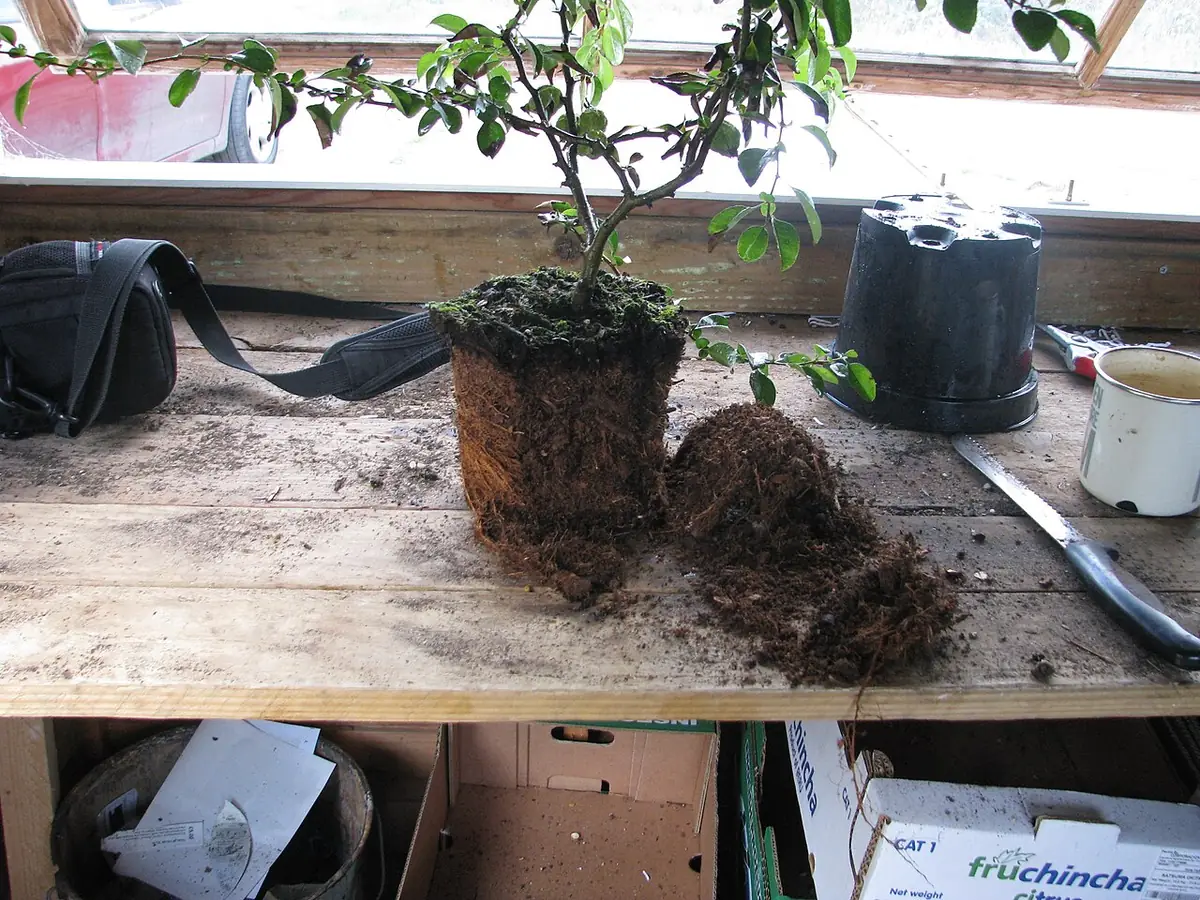
Remove any decorative cover and look at the mix near the original root ball. A crusted surface or shrunken edge is a clue, but examine below it with a gentle finger check or a narrow wooden probe. Avoid stabbing repeatedly through crowded roots. Compare more than one position. If the outside is wet and the center remains hard and dry, the goal is to restore moisture evenly rather than simply increasing the total water poured through the pot.
Start with a small slow application over the surface and give it time to soak in. Repeat in several passes instead of delivering one fast stream into the same place. Gently loosen only an obvious surface crust if that can be done without tearing roots. Do not dig deep holes through the root ball to make water disappear. Those channels can bypass dry material in the same way as the original gap at the pot wall.
Rewet in controlled stages
For a manageable nursery pot, a shallow container of clean water can help moisture enter through the drainage holes. Keep the plant crown above water and observe whether the root ball begins to take it up. Remove the pot once moisture has moved into the mix; do not leave it standing indefinitely. Lift it carefully, let it drain and protect the floor. Very large patio containers are better approached with repeated slow surface watering than unsafe lifting.
Check the center again after rewetting and drainage. A dark surface and a wet saucer do not prove that the full root ball has absorbed water. If a dry core persists, inspect whether the medium has broken down or become tightly packed with roots. Repotting may be appropriate when the plant has outgrown its container or the medium no longer functions, but repeated root disturbance is not the first answer to every short dry spell.
Avoid adding dish detergent or other household liquids as an improvised wetting agent. Their ingredients and concentrations are not designed for your plant or growing medium. If a horticultural product is needed, use one labeled for that purpose and follow its instructions. Ordinary rewetting is often a matter of patient water application and a suitable medium. Fertilizer should wait until roots have a stable moisture environment and the plant is ready for normal growth.
Prevent the next dry gap
After the root ball is evenly moist, restore a routine based on observation. Check it before the center shrinks away from the wall again, especially during hot or windy weather. A smaller pot can move from adequately moist to very dry much faster than a larger one with the same plant. Move a vulnerable container to temporary shelter when appropriate, while keeping light suitable for the plant and avoiding a sudden transition into deep shade.
Some leaves may stay damaged after a severe dry period. Look for restored firmness in healthy tissue and the condition of new growth rather than expecting brown edges to disappear. If wilting continues while the mix is now moist, investigate roots, heat and other possible causes before repeating immersion. Record what the center felt like before and after watering. That simple comparison is more useful than measuring only how much water left the drainage holes.